
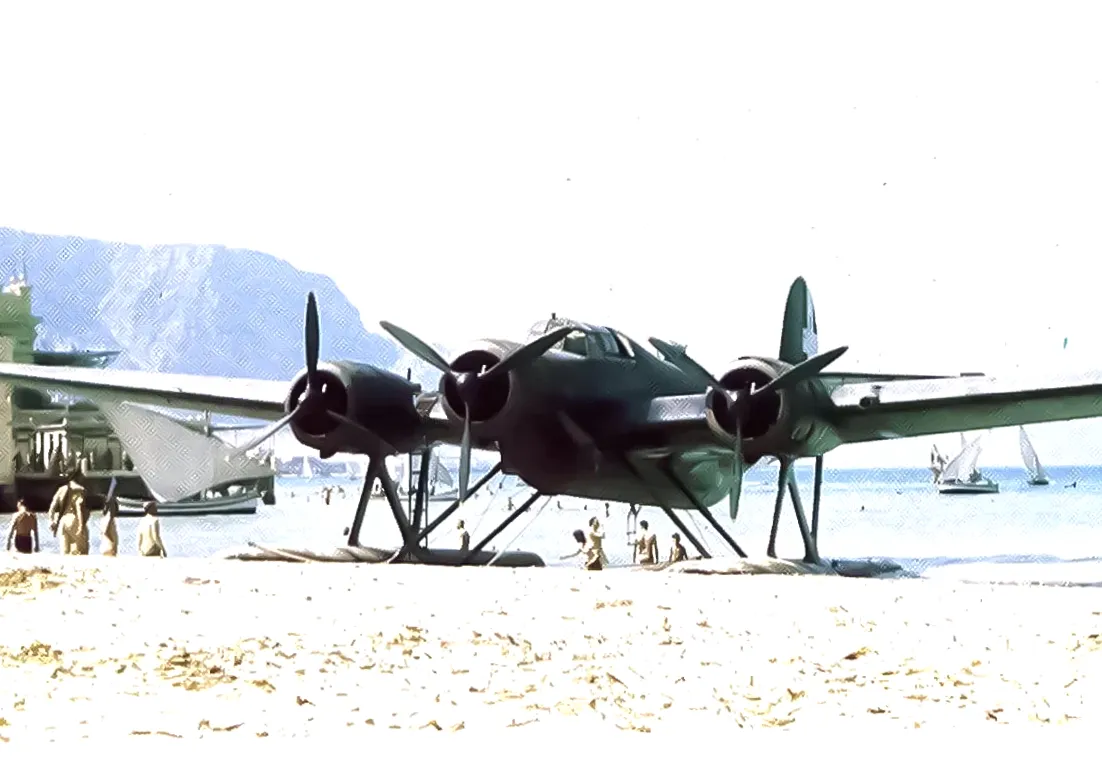
The Italian Air Force of the Second World War is often overlooked, despite entering the conflict with designs proven during the Spanish Civil War. Italian engineers produced several remarkable aircraft, yet their potential was frequently limited by the nations modest industrial capacity. Below is a fully subjective list of ten notable Italian aircraft from that era.
10. Fiat G.50 Freccia (Arrow)
The Fiat G.50, designed by Giuseppe Gabrielli, was Italys first monoplane fighter to feature both a retractable landing gear and an enclosed cockpit. The canopy was soon removed because it was nearly impossible to open during flight, making emergency escapes unsafe. While the G.50 saw modest success in Italian hands, it achieved a remarkable combat ratio when flown by Finnish pilots, who claimed ninety-nine Soviet aircraft while losing only three G.50s. Despite this, the open cockpit made it unpopular in harsh northern winters.
9. Savoia-Marchetti SM.79 Sparviero (Sparrowhawk)
First flown in 1934, the SM.79 became one of the most durable and recognizable Italian aircraft of the war. It earned distinction in the Spanish Civil War as an effective bomber and later became one of the Axis most capable torpedo aircraft. Known for reliability and tough construction, SM.79 squadrons inflicted significant losses on Allied shipping, including damaging major naval vessels. Throughout numerous attacks in 1941 they managed to sink or damage many ships while suffering comparatively light losses.
8. Fiat CR.42 Falco (Falcon)
The CR.42 was a biplane designed when monoplanes were already becoming dominant. Nevertheless, it proved surprisingly effective in the right conditions. Highly manoeuvrable, it challenged early Allied fighters in North Africa and Greece, where Italian pilots claimed over one hundred and sixty aerial victories while losing fewer than thirty aircraft. More CR.42s were built than any other Italian wartime aircraft, demonstrating the biplanes continued relevance despite its outdated appearance.
7. Macchi MC.200 Saetta (Lightning)
The MC.200 combined refinement from Italys racing aircraft heritage with the reliability of a radial engine. Initially equipped with an enclosed cockpit that was soon removed, the Saetta entered service just before the war began and was considered among the best fighters then in operational use. It flew more combat missions than any other Italian type and proved highly agile in North Africa. On the Eastern Front, MC.200 units claimed dozens of Soviet aircraft while sustaining modest losses.
6. CANT Z.506B Airone (Heron)
The Z.506B was a trimotor seaplane of mostly wooden construction that demonstrated excellent performance in rough water. Originally designed as a civilian aircraft, it set early records before being adapted for military use. During the war it performed maritime patrol, torpedo strikes, reconnaissance, and transport duties. One of its most unusual incidents occurred when Allied prisoners hijacked a rescue aircraft and flew it to Malta.
5. Macchi MC.205V Veltro (Greyhound)
A development of the MC.202, the Veltro paired the refined handling of earlier Macchi fighters with a licensed Daimler-Benz DB 605 engine. It was the first Italian fighter with a strong standardized armament of cannon and heavy machine guns. British test pilot Eric Brown described it as among the finest aircraft he ever flew. Many Italian aces scored significant portions of their victories in the MC.205.
4. Piaggio P.108
The P.108 was the only significant heavy bomber produced by the Axis aside from Germanys He 177. First flown in 1939, it matched or exceeded the performance of contemporary Allied heavy bombers in speed and defensive innovation, including remotely operated wing-mounted turrets. Production remained very limited due to Italys restricted industrial resources, but the aircraft itself was considered highly capable.
3. Reggiane Re.2005 Sagittario (Archer)
The Re.2005 was one of the most advanced fighters Italy produced, combining excellent agility with a powerful DB 605 engine. Though only a small number were built due to manufacturing complexity and economic constraints, the aircraft earned a strong reputation among both Italian and Allied pilots. It proved competitive with late-war Allied fighters during operations over Sicily.
2. Fiat G.55 Centauro (Centaur)
Considered the best Italian fighter of the conflict, the G.55 impressed German aviation experts, some of whom regarded it as superior to many Axis designs. Well armed with multiple cannon and machine guns, it had the power and firepower necessary to engage Allied heavy bombers effectively. Production numbers remained modest because it required far more time to build than the Bf 109, despite its excellent performance.
1. Savoia-Marchetti SM.82 Kanguru (Kangaroo)
The SM.82 was the most important Italian transport aircraft of the war and served in large numbers with both Axis and Allied forces after Italys 1943 armistice. Though visually plain and constructed using a mix of steel tubing, plywood and fabric, it could carry substantial loads and even operate as a bomber when needed. Its long-range capabilities allowed daring missions, including a strike on oil refineries in Bahrain, after which aircraft continued to Italian-controlled territory in East Africa. Throughout the war the SM.82 was in constant demand to supply distant fronts, especially in North and East Africa.