

Discussion on Film Production Design featuring 'The Testament of Ann Lee' and 'Train Dreams'
- HOME
- ENTERTAINMENT
- Discussion on Film Production Design featuring 'The Testament of Ann Lee' and 'Train Dreams'
- Last update: 5 hours ago
- 5 min read
- 151 Views
- ENTERTAINMENT
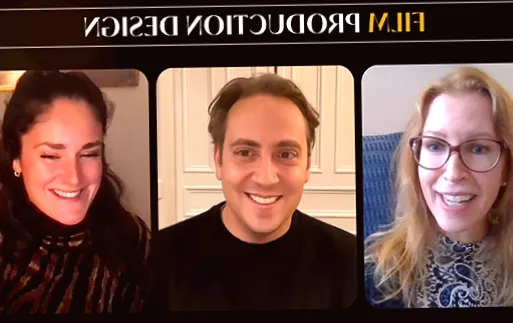
An interesting outcome of bringing together our two panelists for this discussion is the connection between Train Dreams designer Alexandra Schaller and The Testament of Ann Lee designer Sam Bader, who, at the time of our chat, had both seen each other's work. Both designers faced similar challenges and rewards, working in remote locations with limited budgets, and both had memorable scenes involving the controlled burning of structures.
Both Schaller and Bader joined Gold Derby for our "Meet the Experts: Film Production" panel, where they shared insights about their paths into production design, essential skills for the role, and exchanged thoughts on specific design elements in their films.
The Journey to Becoming Production Designers
Gold Derby: Did you both intentionally pursue careers as production designers? Could you share what motivated you to enter this field?
Sam Bader: Did I set out to be a production designer? In a way, yes, but also no. I was an oil painter for much of my life, starting young and focusing on life drawing. My path was more artistic, and I got into college with a painting portfolio. But being at USC, I couldn't escape the film world. Two film producers noticed my art and asked if I had considered designing sets. I had no idea what that involved, but my instincts aligned with the process reading the script, breaking it down, creating a look book, and drawing. Even though I wasn't a film major, I found myself in a production class that led me into film art departments in New York, eventually landing a role on a Spielberg movie.
Alexandra Schaller: I didn't initially know that production design was even a career option. It wasn't until I worked in theater and immersive shows that I started doing some accidental production design. Eventually, I moved to New York and worked on indie films. It was the perfect time, and I worked my way up through small, low-budget movies.
The Key Skills for Production Designers
Gold Derby: Is there one essential tool in your artistic toolkit that helps in your work, like drawing or building skills?
Alexandra Schaller: Every production designer has a personal approach. For me, it's about understanding the feeling of the scene. Often, how something should feel dictates how it should look.
Sam Bader: I agree. While it's a personal process, the ability to communicate clearly is crucial. As designers, we need to articulate our ideas not only to the director and cinematographer but also to the whole team. And sometimes, it's about translating the idea without the help of 3D software or tools. When working in remote locations, its crucial to communicate in the clearest way possible.
The Importance of Teamwork and Leadership
Alexandra Schaller: Communication is key. A production designer often leads a team, and it's essential to get your idea across clearly to the director, producers, and crew. And even though the job is very creative, a significant part is managerial, from working with directors to organizing the team on the ground.
Sam Bader: The ability to judge when to worry and when not to is also essential. Knowing when to delegate and trust your team is a big part of the role. It's also important to ensure that everyone feels creatively invested in the project, as that leads to better work and a happier environment.
Watching Your Finished Work
Gold Derby: When watching the final cut of your films, can you enjoy it, or are you constantly nitpicking?
Alexandra Schaller: Watching the final version of "Train Dreams" at Sundance was a unique experience. By then, I had seen many iterations of the film, but when I watched the final cut on the big screen, it felt entirely different. It was immersive, and I could relax and enjoy it.
Sam Bader: I had a similar experience with "The Testament of Ann Lee." We had gone through many iterations, and I was anxious about how the final product would turn out. But when I saw the Shaker sequence at the end, I felt that we had done our job well. It all came together perfectly.
Practical Effects and Creative Challenges
Gold Derby: Were there any particularly challenging moments in terms of practical effects or creative solutions in your films?
Sam Bader: One of the most challenging scenes was building the Shaker ballroom. It was a mix of working within the constraints of the existing space, which was a barn, while making it fit seamlessly with the iconic Shaker design. The balancing act between the structure's limitations and the visual composition required a lot of detailed work.
Alexandra Schaller: For me, a challenging moment was working on the fire sequence. We wanted to create an authentic and immersive scene, so we used practical effects. The greens team did an incredible job transforming the cabin and its surroundings to make it feel real. I think that's what makes the moment in the film so magical the realism and attention to detail.
Conclusion: The Art of Production Design
Gold Derby: As production designers, how do you balance noticing design in films without being distracted by it?
Sam Bader: If a film is well-made, you don't really think about the design. You get absorbed into the story and characters. When design works, it shouldn't distract; it should support the narrative.
Alexandra Schaller: Exactly. Even bold and stylized design should always be in service of the story. If its well done, it enhances the experience without drawing too much attention to itself.
Sam Bader: If a movie loses me, though, I do tend to scrutinize the design, but thats part of the fun. In the end, good design enhances the film, and that's what we aim for as production designers.
Author: Logan Reeves
Share

Glen Powell & Michelle Randolph's Relationship Is 'Very Fresh' — Source
2 hours ago 2 min read ENTERTAINMENT

'Don Lemon Seeks Revenge on Kathy Griffin for New Year's Eve Show' — Source
2 hours ago 4 min read ENTERTAINMENT

Will Smith and Jada Pinkett Smith Remain a Strong Team despite $3M Lawsuit: 'They Maintain Deep Respect' (Exclusive Source)
3 hours ago 2 min read ENTERTAINMENT

Sabrina Carpenter Moves on from Disney Fame Amid NSFW Lyrics Backlash
3 hours ago 2 min read ENTERTAINMENT

Ex-WWE Star Hornswoggle Shares Insights on Therapy Benefits
3 hours ago 3 min read ENTERTAINMENT

A$AP Rocky Describes Mutual Inspiration with Rihanna
3 hours ago 2 min read ENTERTAINMENT

Country Ever After Star Criscilla Anderson Passes Away at the Age of 45
3 hours ago 2 min read ENTERTAINMENT

Meghan Markle contacts her estranged father following his emergency leg amputation
3 hours ago 3 min read ENTERTAINMENT

Bianca Censori's Race in Dermatology Interrupted by Kanye West's New 'Rules' Resulting in Chaos
3 hours ago 4 min read ENTERTAINMENT
'Motor Neuron Disease claimed our son at 14 - it can affect anyone at any age'
3 hours ago 3 min read ENTERTAINMENT