

The First Close Examination of a Tsunami from Space Uncovers Surprising Characteristic
- Last update: 3 days ago
- 2 min read
- 11 Views
- WORLD
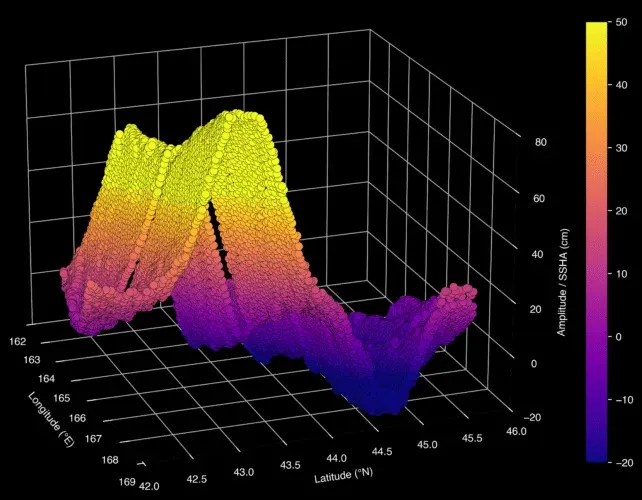
A recent satellite observation has recorded a tsunami with an accuracy never achieved before, offering new insights that could refine tsunami models and improve early warning systems. Launched in 2022 through a collaboration between NASA and the French space agency CNES, the Surface Water and Ocean Topography (SWOT) satellite was built to monitor global water movements by detecting changes in surface height.
While SWOT initially focused on measuring small ocean currents, it unexpectedly captured a significant event. On July 29, 2025, an 8.8 magnitude earthquake struck the Kuril-Kamchatka subduction zone near Russia's southeastern coast, generating a powerful tsunami across the Pacific Ocean just as the satellite passed overhead.
By combining SWOT's observations with data from three nearby buoys in the Deep-ocean Assessment and Reporting of Tsunamis (DART) network, scientists were able to map a tsunami propagation pattern that was more intricate than anticipated. Notably, the findings challenge previous assumptions: large tsunamis were thought to travel largely as single, cohesive waves, but the new data reveal that the wave fragmented into a prominent leading wave followed by smaller waves trailing behind.
The leading wave, depicted in red in the data, reached heights of over 45 centimeters (1.5 feet). The epicenter of the earthquake is marked with a star in the satellite imagery.
"I consider SWOT's data like putting on a new pair of glasses," explained Angel Ruiz-Angulo, the study's lead author and physical oceanographer at the University of Iceland. "Previously, DART buoys only allowed us to observe tsunamis at isolated points across the ocean. Other satellites offered just a narrow view across the wave. SWOT, however, provides a swath up to 120 kilometers wide, capturing high-resolution details of the sea surface."
Thanks to its timing, SWOT could become a critical tool for real-time tsunami detection, potentially providing earlier warnings for coastal regions at risk. The study was published in The Seismic Record.
Author: Sophia Brooks
Share

Man accused of theft for reportedly swallowing Fabergé egg
2 minutes ago 2 min read WORLD
Israeli gas sensor detects identical molecules, paving the way for diagnostics based on breath.
22 minutes ago 3 min read WORLD

Man dies after being backed into by road sweeper
22 minutes ago 2 min read WORLD

Christmas festivities come back to Bethlehem following 2 years of conflict in Gaza
23 minutes ago 3 min read WORLD
Lebanon and Israel conduct first direct talks in decades: source confirms to AFP
27 minutes ago 3 min read WORLD

Is Jared Isaacman set to become NASA's next administrator? Tips for tuning in to the hearing
27 minutes ago 3 min read WORLD

88-Year-Old Army Veteran Can Now Retire Thanks to Influencer's Generous Gift
29 minutes ago 2 min read WORLD

The new world order has already arrived − and here's what it looks like
32 minutes ago 3 min read WORLD

River with foam covering to receive new stock of 3,000 fish
33 minutes ago 1 min read WORLD
Mother confesses to causing the death of her four-year-old son
34 minutes ago 1 min read WORLD