

Religious leaders gather in Turkey to mark 1,700th anniversary of important council.
- Last update: 4 days ago
- 3 min read
- 15 Views
- WORLD
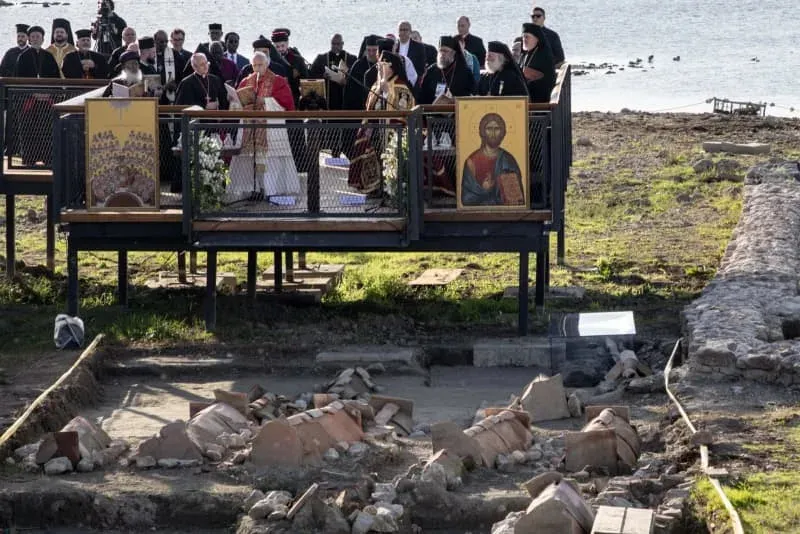
Recently, Catholic officials made a pilgrimage to the basilica located beneath Turkeys Lake Iznik, believed to be the historic site of the First Council of Nicaea, after water levels dropped and exposed the sunken ruins. The basilica was initially discovered in 2014 by a Turkish archaeologist who identified its outline from aerial photographs.
This weekend, prominent Catholic leaders traveled to the site, regarded as one of the most significant locations in Christian history. Archaeologist Mustafa Sahins research points to this as the probable location where the First Council of Nicaea took place in 325 AD.
Ancient Nicaea, now within modern Turkey, hosted the council called by Emperor Constantine I to establish the central Christian doctrine concerning Jesuss divinity and to create the Nicene Creed, a foundation of Christian belief that continues to influence the faith today.
Recent drought conditions revealed the fully submerged remains of the Basilica of St. Neophytos, prompting key Catholic leaders, including Pope Leo XIV, to visit the ruins in commemoration of the 1,700th anniversary of the council.
The council aimed to resolve theological disputes regarding the nature of Jesus Christ, debating whether he was human, divine, or both. The majority of bishops ultimately affirmed that Jesus was "of one substance" with God the Father. A historical anecdote claims that St. Nicholas, later associated with Santa Claus, struck the priest Arius during a heated debate.
In a notable aerial view, visitors observe the Byzantine-era Basilica of Saint Neophytos from a platform in Iznik, Turkey, on November 18, 2025, as preparations continue for Pope Leo XIV's visit marking the 1,700th anniversary of the council.
The council also established rules for calculating Easter, which remains celebrated on different dates by Catholic and Orthodox Christians. The Vatican has indicated that religious leaders are considering efforts to unify the celebration date.
Archaeologists and Catholic authorities cite several reasons supporting this location as the council site. It is the only known 4th-century church in Nicaea, and a Vatican fresco depicts a basilica near a lake, corresponding with Lake Iznik. Evidence also indicates that the site evolved from a martyrs shrine to a wooden church and eventually a stone basilica built over the grave of St. Neophytos, martyred in 303 AD. Numerous Christian burials and relics have been discovered here.
Over the centuries, earthquakes and other natural events damaged the structure, eventually causing its submersion. At one point, it was reportedly converted into a mosque before sinking completely.
Although Iznik today has a predominantly Muslim population, its Christian history remains significant. Following the popes announcement, Christian pilgrims have increased visits to the area, and local businesses have begun selling related memorabilia and souvenirs linked to the basilica.
Author: Sophia Brooks
Share

Prince George remains unfazed by his future responsibilities as a future king — Source
7 seconds ago 2 min read WORLD

Flavio Bolsonaro announces candidacy for Brazil’s 2026 presidential election endorsed by his father
2 minutes ago 4 min read WORLD

Leader of Lithuanian governing party convicted for inciting hatred against Jews
4 minutes ago 2 min read WORLD

Putin promises Russia will take control of Donbas region by any means necessary, while Ukrainians gear up for new US peace negotiations
5 minutes ago 3 min read WORLD
Attracted by high-paying job opportunities, Kenyans demand the return of their sons sent to fight for Russia.
12 minutes ago 6 min read WORLD

3-Year-Old Ryker Webb's Life After Surviving 2 Days Alone in the Wilderness
13 minutes ago 3 min read WORLD

American and Ukrainian officials to meet again on Saturday to discuss peace plan
20 minutes ago 4 min read WORLD
Billingsgate and Smithfield markets could relocate to a new site at Royal Docks
22 minutes ago 3 min read WORLD

Survivors of boat strike on Sept. 2 were signaling for help before second attack, sources report
24 minutes ago 3 min read WORLD
Netanyahu appoints Military Secretary Roman Gofman as next Mossad chief
27 minutes ago 2 min read WORLD