

Louisiana's Decreasing Size Sparks Tribal Efforts to Safeguard Communities
- Last update: 1 hours ago
- 4 min read
- 959 Views
- WORLD
POINTE-AU-CHIEN, La. Cherie Matherne gazed over Bayou Pointe au Chien, now broad enough for multiple boats to navigate. In the distance, dead tree stands mark where saltwater surges during storms. This area was once narrower, shallow enough for only small boats, with vast forests whose canopies almost blocked out sunlight. Land that once supported grazing cattle is now submerged.
For generations, Louisianas fragile coastline has been steadily disappearing. The Pointe-au-Chien Indian Tribe, along with other Indigenous communities, are working to protect their remaining lands and adapt to environmental changes. Their efforts include building temporary reefs to slow erosion and constructing sturdier homes capable of withstanding severe storms.
Our goal is to allow people to stay here as long as they wish, said Matherne, the tribe's operations director. The tribe seeks to avoid the displacement experienced by the nearby Jean Charles Choctaw Nation, which relocated 40 miles north three years ago after losing 98% of Isle de Jean Charles to the Gulf of Mexico.
Factors Driving Coastal Loss
Louisianas coastline is retreating due to several human and environmental factors. Levees along the Mississippi River interrupt the natural deposit of sediment, essential for sustaining wetlands. Canals allow saltwater to penetrate, killing freshwater vegetation and accelerating erosion. Groundwater extraction causes subsidence, while climate change intensifies hurricanes and sea level rise. Since the 1930s, the state has lost roughly 2,000 square miles of land. At peak erosion, the U.S. Geological Survey found that a football field-sized section of wetlands vanished every 34 minutes.
Sam Bentley, a geology professor at Louisiana State University, noted that without sediment from the Mississippi, entire ecosystems, communities, and infrastructure are at risk. Indigenous burial grounds and cultural sites face erosion, while traditional practices like shrimping, fishing, and subsistence farming are increasingly under threat. Researchers predict Louisiana could lose up to 3,000 square miles within 50 years if trends continue.
Reefs from Recycled Oyster Shells
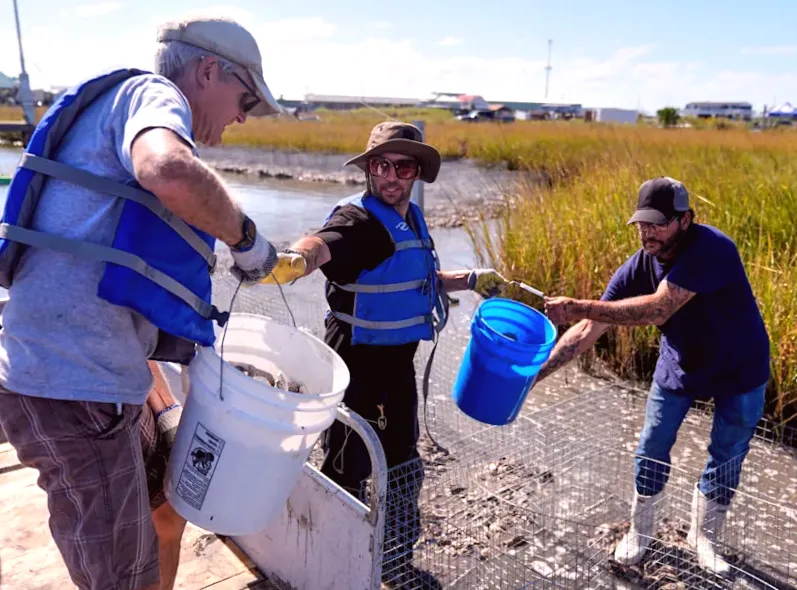
One method to combat erosion involves creating reefs from recycled oyster shells. Collected from restaurants, the shells are bagged and placed offshore to form protective barriers. Since 2014, the Coalition to Restore Coastal Louisiana has recycled over 16 million pounds of shells, safeguarding roughly 1.5 miles of shoreline.
The Pointe-au-Chien tribe had a 400-foot reef built in 2019 to protect a historic mound, resulting in a 50% reduction in land loss at the site, according to James Karst of the coalition. However, oyster shell reefs are limited by availability, cost, and the need for specific salinity levels, so they are mainly deployed at culturally important locations.
Recent projects include a reef about 30 miles southwest of Pointe-au-Chien with the Grand Caillou/Dulac Band of Biloxi-Chitimacha-Choctaw Tribe, designed for public education on coastal restoration.
Storm-Resistant Homes
Hurricane Ida in 2021 brought winds of 150 mph, damaging many homes in Pointe-au-Chien. Most residents returned with support from the Lowlander Center, a nonprofit assisting Indigenous communities at risk from climate threats. Homes are now elevated, reinforced with hurricane straps, and equipped with durable doors, windows, and raised electrical systems. Thirteen homes have been rebuilt or repaired, with plans for five new homes and further fortifications underway.
Safety is community-wide. One home isnt enough, said Kristina Peterson of the Lowlander Center.
Ongoing Challenges
State-recognized tribes face hurdles in obtaining federal recognition, which limits access to grants and aid. Funding cuts from previous administrations have further hampered projects like community centers and solar panel installations for homes.
A Changing Landscape and Enduring Spirit
Pointe-au-Chien elder Theresa Dardar has witnessed dramatic changes over 50 years, including expanded ponds and merged lakes. Hunting and walking through once-dense woods is now rare. Yet, the communitys closeness, quiet, and traditional fishing persist. This is where our ancestors were, and leaving would feel like abandoning them, Dardar said.
Through erosion control and resilient housing, the tribe hopes to attract younger families and protect inland areas. We serve as a buffer, Dardar added.
Author: Ethan Caldwell
Share

Suspected Ukrainian strike leaves sanctioned oil tanker stranded off Bulgaria's Black Sea coast
1 hours ago 2 min read WORLD

How would Canada, US and Mexico perform in their World Cup groups?
1 hours ago 3 min read WORLD

Bethlehem Christmas tree shines bright for the first time since the beginning of the Gaza war
1 hours ago 3 min read WORLD

Expert: Prince William Quietly Transforming Monarchy's Traditions
1 hours ago 2 min read WORLD

Achieving lasting peace in Ukraine could depend on the presence of independent monitors - however, Trump's 28-point plan barely acknowledges their importance.
1 hours ago 3 min read WORLD

Russia extends US citizen Gilman's jail sentence by 2 years, state media report
1 hours ago 1 min read WORLD
Nature retracts German study on worldwide expenses of climate change
1 hours ago 2 min read WORLD

Machado, the winner of the Peace Prize, is 'doing everything' to attend the ceremony
1 hours ago 2 min read WORLD

Ukrainian strike leaves sanctioned oil tanker stranded off Bulgaria's Black Sea coast
1 hours ago 2 min read WORLD

'We must stay united': Top EU diplomat supports partnership with US
1 hours ago 2 min read WORLD