

LandSpace, a Chinese company, unsuccessful in conducting reusable rocket test.
- Last update: 3 days ago
- 3 min read
- 235 Views
- WORLD
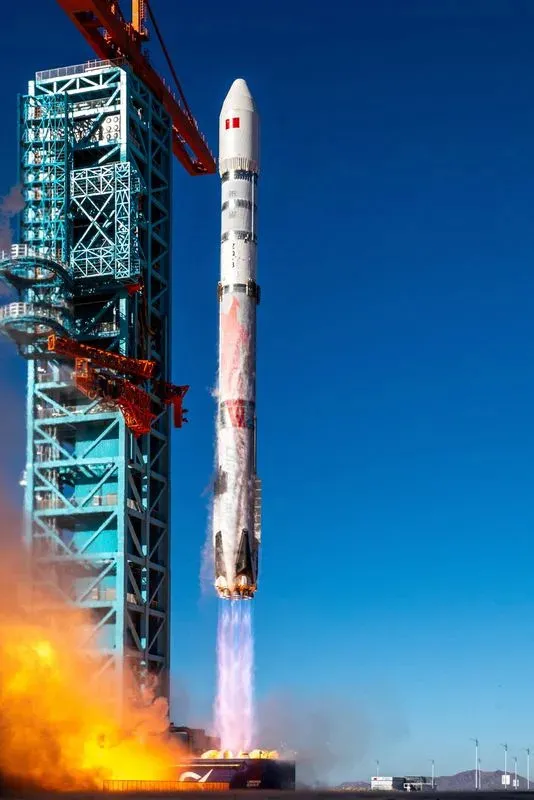
BEIJING/WASHINGTON, Dec 3 LandSpaces first flight of its next-generation Zhuque-3 rocket ended unsuccessfully on Wednesday, halting the Chinese company's ambition to join SpaceX and Blue Origin as operators of reusable spacecraft. According to state media Xinhua, the rocket could not complete a controlled landing after launch.
"An abnormal combustion event occurred during the process, preventing a soft landing on the recovery pad," Xinhua reported. "The recovery test failed, and the specific cause remains under further investigation."
The unsuccessful landing underscores the difficulties involved in creating rockets that can be reused after orbital missions. LandSpace stated it will analyze the flight data to enhance its rocket recovery systems.
If China succeeds in deploying its first domestically developed reusable orbital rocket, it could accelerate national space ambitions by allowing more frequent launches and reducing costs, particularly for large satellite constellations similar to SpaceX's Starlink.
"As low-orbit constellation deployment grows, Zhuque-3 will advance from recovery trials to routine reuse, ultimately aiming for airline-like operational frequency, supporting Chinas space-power goals," LandSpace commented.
SpaceX, a pioneer in commercial rocket reusability, demonstrated the potential of reusable boosters with the Falcon 9 nearly a decade ago, disrupting traditional U.S. launch operations that relied on expendable rockets. The reusable Falcon 9 stage enabled faster Starlink satellite launches beginning in 2019 and helped SpaceX dominate the global satellite communications market.
In October, Elon Musk praised the Zhuque-3 design, suggesting it could rival the Falcon 9. LandSpace indicated that a fully matured Zhuque-3 could be reused at least 20 times and transport up to 18 tonnes of satellites. However, bridging the gap with SpaceX remains uncertain. The Falcon 9 experienced two failed landings before its first success in 2015, illustrating the challenges of reusable rocketry.
Despite the setback, Zhuque-3s inaugural flight positions LandSpace ahead of domestic competitors such as iSpace, Galactic Energy, and Deep Blue Aerospace, which are developing smaller or less advanced systems. It also represents the first Chinese attempt at a reusable vehicle comparable to Falcon 9.
Reusable rockets require precise, high-energy maneuvers. After stage separation, boosters must reorient in space, decelerate, survive supersonic atmospheric reentry, and reignite engines just before landing. Timing errors of mere milliseconds or incorrect angles can result in failure.
Currently, only SpaceX has consistently achieved this, routinely landing and re-flying Falcon 9 boosters. Decades of experience and dozens of reusable boosters have made the company a leader in medium- and heavy-lift orbital launches worldwide.
Other firms in China, Europe, India, and the U.S. are developing reusable rockets, but none match SpaceXs flight record or production capacity, leaving the company dominant in the global reusable launch sector.
Author: Sophia Brooks
Share
CCTV footage requested following theft of £2k from elderly man
8 seconds ago 1 min read WORLD
Federal government files lawsuit against real estate developer for mishandling protected land: '3,000 artifacts lost or destroyed'
2 minutes ago 2 min read WORLD

Philippines reports China fired flares at its patrol plane in the contested South China Sea
4 minutes ago 2 min read WORLD

Experts say Florida Crunch Fitness may be the cause of a Legionnaires 'outbreak'
5 minutes ago 2 min read WORLD

Waymo autonomous taxi drives passengers into apparent police standoff
6 minutes ago 1 min read WORLD

Arizona congresswoman claims she was pepper-sprayed at ICE protest.
7 minutes ago 2 min read WORLD

Zara Aleena's relative urges for law requiring action in case of danger
8 minutes ago 3 min read WORLD

Opinions wanted on proposal to enhance air quality
9 minutes ago 1 min read WORLD

Caution about waves hitting coastal roads
12 minutes ago 1 min read WORLD

Children injured when school bus roof torn off by bridge
13 minutes ago 1 min read WORLD